How to Repair Electric Gates: Safe Checks First, Then When to Call an Engineer
Your electric gate has stopped halfway down the driveway, and you are not sure whether to touch it. That hesitation is right. These gates move with enough force to injure a child or damage a car, and mains voltage sits inside the control box.
By the end of this article you will know which checks are safe to try yourself, such as remotes, batteries, photocells and obstructions, and which faults belong to an engineer. You will also know when to call AutoGate Northern Ireland, what Adrian needs to diagnose the fault, and what a repair should cost before you agree to it.
What Is AutoGate Northern Ireland? Who Repairs Electric Gates Here
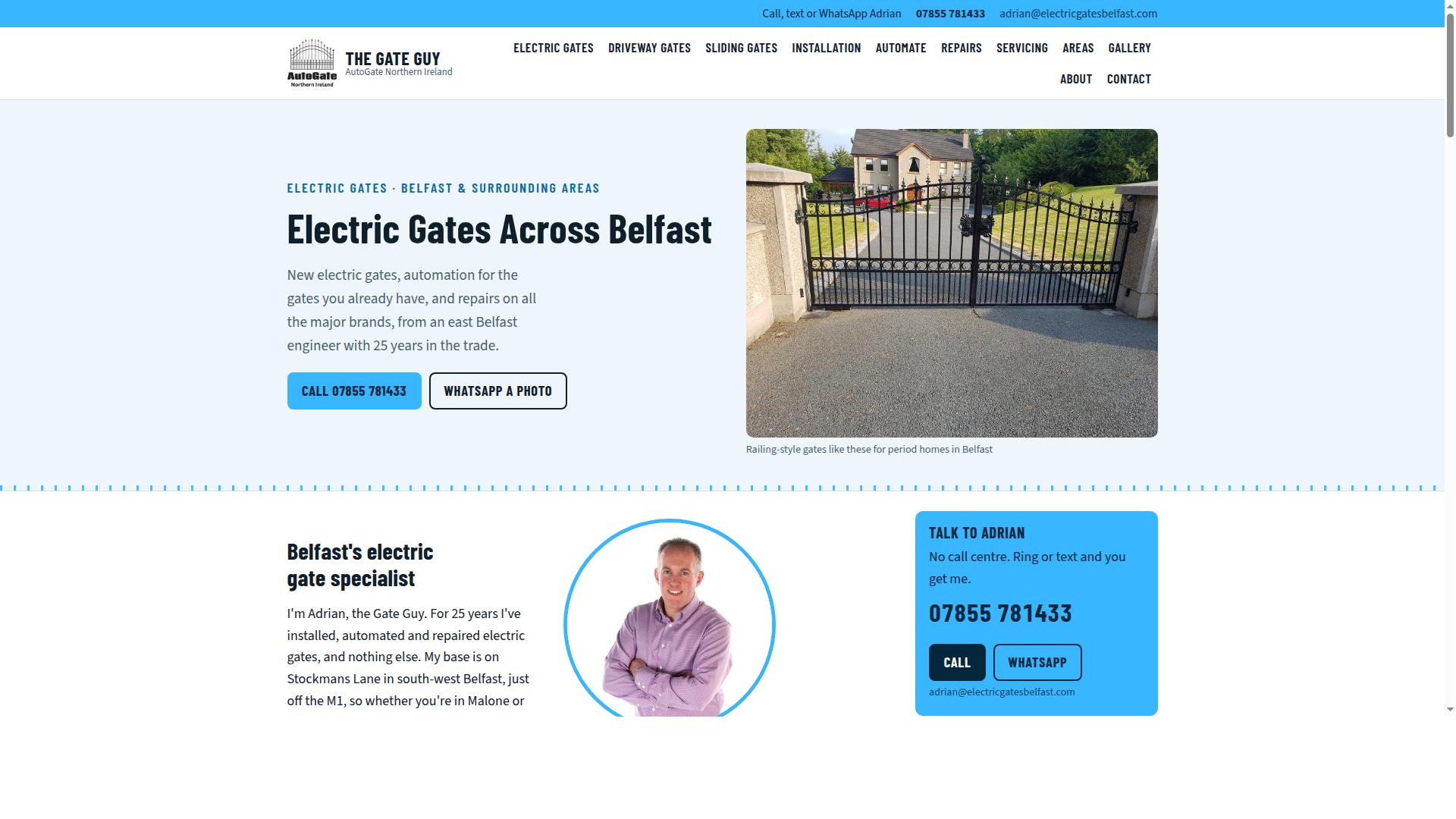
AutoGate Northern Ireland is a Belfast-based electric gate specialist run by Adrian McGivern, known locally as 'the Gate Guy'. He works from 110 Stockmans Lane, Belfast BT9 7JE, just off the M1, with offices in Lisburn and Newry.
The business is owner-run. There is no call centre and no middleman. When you ring about a gate that has stopped working, you deal with Adrian from the first visit through to handover.
He has spent over 25 years in electric gate installation and repair. That length of time matters when a fault is tricky, because pattern recognition on control boards, motors and safety circuits only comes with years of hands-on work.
Adrian is a Belfast based electric gate engineer with a BEng in Electrical Engineering and an MBA from Ulster University. He also holds City & Guilds qualifications in electrical installation and in inspection and testing. He is a founding member of BIGAA, the British and Irish Gate Automation Association.
His work is checked against the standards that matter for gate safety. Every installation is force tested to BS EN 12453, and electrical work follows BS 7671, the UK wiring regulations. Handover includes a Declaration of Conformity and the manuals.
He repairs all types and makes of automatic gate, whoever installed it. That covers the common brands you will find on driveways across Northern Ireland:
- Beninca, CAME, FAAC and BFT
- Nice, SEA, Gibidi and Allmatic
- V2, Key Automation and Chamberlain LiftMaster
- DEA System and Fadini
Sliding gates, swing gates with overground or underground motors, and heavy-duty hydraulic setups are all within his remit. Homes, farms and businesses across Belfast and the surrounding towns use him, from Bangor and Newtownards to Armagh, Banbridge and Downpatrick.
Repairs carry a 12-month warranty, and every job is quoted after a site visit. Quotes are free with no obligation, so you know the figure before any work starts. If a repair is not worth doing, he will tell you that plainly rather than push a replacement.
Safe Checks Before You Touch Anything
Before you go near a gate that's stuck open, half-closed or making a strange noise, treat it as live and dangerous until you've proved otherwise. Most electric gate faults sit on the mains side of things, and the moving parts are heavy enough to do real damage.
So the first job is always the same: make the gate safe. Not diagnose it, not wiggle a wire, just make it safe. Under BS EN 12453, an automatic gate is classed as machinery with real entrapment risk, which is why the checks below come before anything else.
Get this part right and the rest is far less risky. Skip it and you're working on a live gate motor with a few hundred kilos of steel waiting to move.
Power Down, Then Confirm What You're Dealing With
Find the isolator or breaker that feeds the gate control panel and switch it off, then lock it off or tape it so nobody can turn it back on while you're working. The supply is often a fused spur indoors or a breaker in the consumer unit, but plenty of Northern Ireland installations have a cabinet near the gate itself.
Once it's off, prove the supply is dead. Use a voltage tester or multimeter at the control panel terminals, not just at the switch. Test between live and neutral, live and earth, and neutral and earth. If your tester shows nothing, good. If you're not sure how to do this properly, stop now.
Two things catch people out. First, capacitors can hold charge for a while after the power is off, so don't go poking at the control board. Second, some gates have battery backup that keeps the panel live even with the mains isolated, so look for a battery and disconnect it too.
Only then use the manual release or emergency release key to move the gate by hand. It should move freely. If it fights you, something mechanical is binding, and forcing it will make things worse.
If you can't confidently prove the supply is dead, or you can't find the isolator, stop and call a gate engineer. That's not defeat, that's sense. BS 7671 exists because mains electricity doesn't forgive guesses.
Checks You Can Do Yourself: Remotes, Batteries, Photocells and Obstructions
Plenty of 'broken' gates are down to a flat remote battery, a dirty photocell lens or a stone jammed in the track. These are the jobs worth trying before you spend money on a call-out.
- Remote control: replace the battery first, then re-pair it if the gate still ignores it. If one remote works and another doesn't, it's almost always the remote.
- Photocells and safety sensors: wipe the lenses with a cloth and check they still line up with each other. If the gate reverses immediately after starting to close, a blocked or misaligned beam is the usual culprit.
- Gate track and rollers: clear leaves, grit and moss, then check the gate rolls smoothly by hand once isolated. Grinding or jumping usually means worn rollers or a track that needs cleaning out.
- Obstructions: look along the full travel of the gate for anything fouling it, including overgrown hedges and loose gravel.
- Manual release: make sure the key or lever works, because you'll want it during a power cut.
Be honest with yourself about what these checks can prove. They sort a good share of call-outs, but they don't replace a proper service. A fault diagnosis on the control board, force testing under BS EN 12453, or hinge alignment and limit switch work is a job for someone with the right gear and insurance.
If the gate still misbehaves after the basics, that's your cue to ring Adrian at AutoGate Northern Ireland rather than dig deeper into the panel yourself.
Faults You Should Never Fix Yourself
Some faults look simple but carry real risk of electric shock or a gate that crushes, so they belong with a qualified gate engineer. The line between a safe DIY check and a dangerous job is drawn by two things: mains electrical work and safety-critical force settings.
If a job involves opening the control panel, touching mains wiring, or changing how hard the gate pushes, stop and call a professional. A quick look at the gate track, rollers or a blown fuse is fine. Anything beyond that is not worth the risk to you or your family.
Why Gate Automation Is Not a DIY Job: Force, Crush Risk and BS EN 12453
An electric gate can exert hundreds of newtons of force, and BS EN 12453 sets limits on that force to stop people, especially children, being trapped or crushed. In plain terms, the standard requires automatic gates to have force limiting and obstruction detection so the gate stops or reverses if it hits something.
It also covers safety edges and photocells that spot a person or vehicle in the gate's path. These parts only work if they are wired and set up correctly, and that is where DIY work often goes wrong.
BS EN 12453 also calls for documented force testing at installation and again after any repair that could affect the gate's movement. That means measuring the actual force and recording the result, not just watching the gate close and hoping for the best.
Some jobs need a competent gate engineer, full stop:
- Replacing or reprogramming a control board
- Adjusting torque or force settings on the gate motor
- Wiring safety sensors, photocells or safety edges
- Modifying the safety circuit in any way
- Any mains wiring, which must meet BS 7671
Be wary of cheap DIY kits sold as a weekend project, and of cowboy installers who skip force testing to save time. A proper handover includes a Declaration of Conformity, a document that shows the gate meets the relevant standards. If nobody offers you one, ask why.
This is exactly where Adrian at AutoGate Northern Ireland draws the line. He would rather tell you a job needs a qualified engineer than see you take a chance with a moving gate. A gate that crushes is not a small problem, and no saved callout fee is worth it.
When to Call an Engineer - and What to Have Ready
If the gate won't move after your basic checks, moves erratically, or has any burning smell or tripped breaker, it's time to call an engineer. Those are not faults to work through yourself. A gate that behaves unpredictably is a moving gate danger, especially where children or pets use the driveway.
Watch for these red flags. Any one of them means stop and pick up the phone:
- Repeated tripping of the breaker or fuse, which points to an electrical hazard rather than a mechanical niggle
- A burning smell from the control panel or motor, which can mean a failing capacitor, control board or wiring
- The gate reversing at random, often a sign of a faulty safety edge, photocells or encoder
- Error codes on the control panel that come back after a reset
- A gate that won't stay closed, which is a security and entrapment risk
None of these are jobs for a screwdriver and a YouTube video. Mains voltage sits inside that control panel, and BS 7671 exists for good reason. A gate engineer will isolate the power properly, test the circuit and check the safety sensors before touching anything else.
One honest note. If the motor is old, the gearbox is worn and parts are hard to find, a repair may not be worth the money. Adrian will tell you that straight rather than take the job anyway.
What Adrian Needs to Diagnose the Fault Before a Visit
A few details before the visit can save time and often let Adrian bring the right part first time. He is a Belfast based electric gate engineer and deals with customers himself, so what you send goes straight to the person doing the fault diagnosis.
Have these ready before you call, text or WhatsApp:
- The make and model of the gate and the gate motor, if you know them. A photo of the motor label works fine
- Photos of the control panel inside the housing, plus any error lights or codes showing
- A plain description of what happens, for example "clicks but doesn't move" or "opens fine but won't close"
- Whether the gate runs on mains supply or has battery backup fitted
- When it last worked properly, and anything that changed beforehand, such as a power cut or storm
You can call, text or WhatsApp on 07855 781433, or email adrian@electricgatesbelfast.com. AutoGate Northern Ireland covers Belfast, Lisburn, Newry and across Northern Ireland, with the base at 110 Stockmans Lane, Belfast BT9 7JE, just off the M1.
Adrian has over 25 years in electric gates and repairs Beninca, CAME, FAAC, BFT, Nice, SEA, Gibidi, Allmatic, V2, Key Automation and Chamberlain LiftMaster systems, plus DEA and Fadini, whoever installed the gate originally. Repairs carry a 12-month warranty. Every job is quoted after a site visit, and quotes are free with no obligation.
Repairs, Servicing and Warranty: How AutoGate Northern Ireland Handles It
AutoGate Northern Ireland repairs all types and makes of electric gate, whether or not they installed it, and every repair comes with a 12-month warranty. Adrian handles each job himself, so you deal with the person doing the work, not a call centre.
The first step is always fault diagnosis on site. He checks the gate, the gate motor, the control board and the safety sensors before touching anything, then explains what has gone wrong in plain terms.
You get honest options, not a sales pitch. If a simple fix will do, such as a replacement capacitor, a fuse or a reset limit switch, that is what he will suggest. If a repair is not worth doing, he will say so rather than take your money for a job that will not last.
That matters most on older gates where the gearbox is worn out or the control panel is obsolete. Sometimes a new motor or a fresh automation setup is the cheaper route over a few years, and Adrian will tell you that straight.
A service is not just a quick look and a squirt of oil. It covers:
- Safety checks and force testing to BS EN 12453, so the gate stops and reverses as it should
- Testing photocells and safety edges for obstruction detection
- Lubricating the gate track, rollers, hinges and drive chain
- Tightening fixings and checking hinge alignment
- Checking the manual release and battery backup work
- Looking over the mains supply and wiring to BS 7671
Regular servicing catches small faults before they become entrapment risks or leave you locked in. It also keeps the moving gate danger low for children, pets and visitors.
Every installation comes with a 3-year warranty, and every repair with a 12-month warranty. Servicing is priced on request, and quotes are free with no obligation after a site visit.
Adrian is a founding member of BIGAA, the British and Irish Gate Automation Association, and works to BS EN 12453 for gate safety and BS 7671 for electrical work. He is a Belfast based electric gate engineer with 25 years in the trade and a BEng in Electrical Engineering from Ulster University.
For a fault you cannot safely sort yourself, that mix of proper qualification and straight advice is exactly what you want from a gate engineer.
Pricing for Repairs and Automation
Prices are straightforward: sliding gate automation starts from £1,400, overground swing gate automation from £1,800, and underground swing automation from around £2,400. Those figures are starting points, not a fixed menu. The final price depends on gate size, design and materials.
For an electric gate repair, the cost depends entirely on the fault and the parts needed. A faulty safety edge or a blown fuse is a very different job from a failed control board or a seized gearbox. That is why every job is quoted after a site visit, and quotes are free with no obligation.
You will know the figure before any work starts. Adrian is Belfast based and deals with customers himself, so there is no call centre passing messages. If a part has to be ordered, you hear about it directly.
Heavy-duty hydraulic automation is priced differently. Fadini hydraulic systems are priced on assessment, because the condition of the gate and the existing rams matters far more than a list price. There is no honest way to quote that over the phone.
One thing worth saying plainly: on an old gate, a repair can sometimes cost more than the gate is worth. If that is the case, Adrian will tell you so rather than take the money. A gate engineer who talks you out of a bad job is worth keeping.
Who This Repair Service Suits
This service suits homeowners whose driveway gate has stopped working, business owners with an entrance gate that needs automating or fixing, and anyone who's inherited a gate from a previous installer. If the gate won't open, opens halfway, or has started making a noise you don't like, that's the sort of job AutoGate Northern Ireland takes on.
Homeowners usually come to it for two reasons: safety and convenience. A gate that stops mid-swing or closes on its own is a moving gate danger, especially with children or pets about. Adrian checks the safety sensors, photocells and obstruction detection as part of the repair, then force tests the gate to BS EN 12453 so you know it's safe to use again.
Business owners are a big part of the work too. That covers automating an entrance that's still opened by hand, and repairing a gate that's blocking staff or deliveries. Homes, farms and businesses across Northern Ireland are all covered, from long farm lanes to short city driveways around Belfast.
Plenty of calls come from people with a gate installed by someone else. Adrian repairs Beninca, CAME, FAAC, BFT, Nice, SEA, Gibidi, Allmatic, V2, Key Automation and Chamberlain LiftMaster, plus DEA and Fadini, whoever fitted them originally. You don't need paperwork or a relationship with the original installer to get it looked at.
One honest point on cost. A repair carries a 12-month warranty, and if a gate motor or control board is old and parts are hard to find, Adrian will tell you when a repair isn't worth doing. Sometimes putting money towards new automation makes more sense, and you'll get that said plainly rather than being sold a fix that won't last.
Coverage runs across Belfast and the towns around it, with offices in Lisburn and Newry. Adrian is Belfast based and deals with customers himself, so you're not passed to a call centre. Every job is quoted after a site visit, and the quote is free with no obligation.
Final Verdict
For electric gate repair in Northern Ireland, a small owner-run firm with 25 years' experience and proper safety credentials is a sensible choice over a cheap DIY fix. The safe checks in this guide are worth doing yourself. The rest is not.
Anything involving force settings, mains wiring or the control board should go to a qualified gate engineer. That is not fussiness. It is the difference between a gate that stops when it meets a child and one that does not.
Here is the honest split of what you can safely do and what you should hand over:
- Do it yourself: visual checks, clearing the track, testing the remote, checking the manual release, looking for damaged photocells or a safety edge that looks crushed
- Leave to an engineer: force testing to BS EN 12453, any 230V mains work to BS 7671, control board faults, limit switch and encoder setup, torque settings, and anything that needs a multimeter on live circuits
If the gate is jammed open, the motor is humming without moving, or a fuse keeps blowing, stop pressing the remote and ring someone. Forcing a stuck automatic gate can damage the gearbox or the drive chain, and that turns a small repair into an expensive one.
For Belfast and across Northern Ireland, AutoGate Northern Ireland is a straightforward option. Adrian is a Belfast based electric gate engineer and the only properly qualified engineer in the electric gate installation industry in Northern Ireland. He is a founding member of BIGAA, the British and Irish Gate Automation Association, and every job is force tested to BS EN 12453 with electrical work to BS 7671.
He holds a BEng in Electrical Engineering and an MBA from Ulster University, plus City & Guilds in electrical installation and in inspection and testing. Repairs carry a 12-month warranty, installations carry 3 years, and the business is fully insured. You deal with Adrian himself, not a call centre. He repairs Beninca, CAME, FAAC, BFT, Nice, SEA, Gibidi, Allmatic, V2, Key Automation, Chamberlain LiftMaster, DEA and Fadini, whoever fitted the gate originally.
One last bit of honest advice. If a gate is old, rusty and the control panel is obsolete, a repair may not be worth the money. Ask for a straight answer on that before you spend. A free site visit and quote with no obligation is the sensible way to decide.
Phone, text or WhatsApp: 07855 781433
Email: adrian@electricgatesbelfast.com
Address: AutoGate Northern Ireland, 110 Stockmans Lane, Belfast BT9 7JE, just off the M1. Offices also in Lisburn and Newry.
Website: electricgatesbelfast.com
Frequently Asked Questions
What safety checks can I do myself before calling an engineer?
Start with the obvious: check the power supply and any isolator switch, confirm the control box has power, and make sure the manual release is working so the gate can be moved by hand if needed. Look for physical obstructions, damaged tracks or worn hinges, and check that safety devices such as photocells are clean and unobstructed. If anything involves opening the control box, testing force limits or working on wiring, stop there and leave it to a qualified engineer.
My gate has stopped working - can AutoGate Northern Ireland help even if another company installed it?
Yes. AutoGate Northern Ireland repairs all types and makes of electric gate, whoever installed them, including Beninca, CAME, FAAC, BFT, Nice, SEA, Gibidi, Allmatic, V2, Key Automation and Chamberlain LiftMaster, as well as DEA and Fadini systems. Adrian is a Belfast based electric gate engineer with over 25 years in electric gates, and repairs carry a 12-month warranty.
What information should I have ready when I contact AutoGate Northern Ireland about a fault?
A photo or short video of the gate, the motor and the control box labels helps diagnose the fault before a visit, so have these ready if you can. You can call, text or WhatsApp 07855 781433, email adrian@electricgatesbelfast.com, or use the contact form on electricgatesbelfast.com. Adrian deals with customers himself, so you speak directly to the engineer rather than a call centre.
When should I stop troubleshooting and call an engineer instead?
Stop as soon as a check involves the control box internals, mains wiring, force settings or safety device adjustment - these need proper test equipment and qualification. Also call an engineer if the gate moves unpredictably, fails to reverse on obstruction, or has been damaged by impact, as these are safety-critical faults. Every installation by AutoGate Northern Ireland is force tested to BS EN 12453 and electrical work is carried out to BS 7671, so safety-critical work should always be done to that standard.
Can you give me a price for a repair over the phone?
It isn't possible to give a fixed price for a repair without seeing the fault, but AutoGate Northern Ireland offers free, no-obligation quotes following a site visit. For context, automation starting prices are listed on the website - for example sliding gate automation from £1,400 and overground swing gate automation from £1,800 - with the final price depending on gate size, design and materials. Servicing prices are available on request.
What warranty do I get on repairs and installations?
AutoGate Northern Ireland provides a 12-month warranty on all repairs and a 3-year warranty on all installations. Every installation is force tested to BS EN 12453, the electrical work is to BS 7671, and handover includes a Declaration of Conformity and manuals. The business is also fully insured with public and employers' liability cover.