Money and renting
Renting against owning
The comparison is almost never the one people make. Rent is not thrown away and ownership is not free; the difference is which costs you can see.
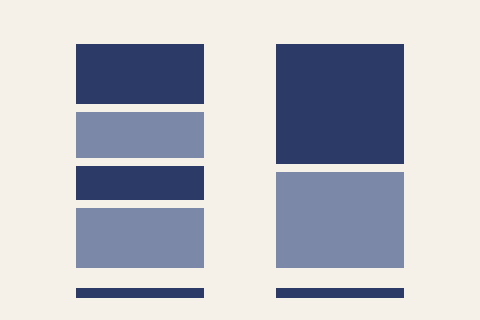
The comparison that does not work
The usual version sets a monthly rent against a monthly mortgage payment and concludes that whichever is smaller wins. This fails in both directions. The mortgage payment is not all cost: the principal portion is money moving from one of your pockets to another, and it comes back when you sell. But the payment also excludes several genuine costs of owning that a tenant simply does not carry - the maintenance, the insurance of the building, the local taxes where the owner pays them, and the very large one-off costs of buying and later selling.
Set against that, rent is not wasted money either. It buys occupation of a building for a period, with no exposure to its value, no responsibility for its roof and no cost to leave. It is a service being purchased, and describing it as throwing money away is as odd as saying the same about the interest portion of a mortgage payment, which is exactly what it is.
Compare like with like: annual cost of occupation
The honest comparison is the total annual cost of occupying an equivalent home, counting only money that leaves and does not come back. For a tenant that is the rent, tenant's contents insurance, and whatever bills the tenancy makes them responsible for. For an owner it is the interest - not the principal - plus building insurance, maintenance, any service charge or ground rent, applicable local taxes, and an amortised share of the cost of buying and one day selling. To that should be added the return the deposit would have earned elsewhere, because capital tied up in a house is capital not doing anything else.
Assumptions, all stated and none observed: a price of 250,000 currency units, a deposit of 50,000, a loan of 200,000 at 5.0 per cent over 25 years, an equivalent home rented at 1,100 a month, maintenance accrued at 1.0 per cent of price a year, building insurance of 400 a year, contents insurance of 120 a year, buying costs of 3 per cent and selling costs of 2 per cent of price, a 3.0 per cent return forgone on the deposit, and a stay of 8 years. Local taxes are omitted because they fall on the occupier either way.
| Cost that does not come back | Side | Amount over 8 years (currency units) |
|---|---|---|
| Mortgage interest over 8 years | Owning | 72,699 |
| Maintenance accrued at 1.0% of price a year | Owning | 20,000 |
| Building insurance | Owning | 3,200 |
| Cost of buying (3% of price) | Owning | 7,500 |
| Cost of selling (2% of price) | Owning | 5,000 |
| Return forgone on the deposit at 3% a year | Owning | 12,000 |
| Total cost of owning | Owning | 120,399 |
| Rent at 1100 a month | Renting | 105,600 |
| Tenant's contents insurance | Renting | 960 |
| Total cost of renting | Renting | 106,560 |
Every figure in that table is arithmetic from the assumptions printed above it, and nothing in it is a market observation. Change any assumption and the answer changes, often enough to reverse it. The point is not the result but the method: count the money that does not come back, on both sides, over the period you will actually stay.
Transaction costs and the length of stay
The costs of buying and selling are the reason the answer depends so heavily on how long you will stay. They are large, they are incurred twice, and they are spread across however many years you are there. Over a long occupation they become a rounding error. Over two or three years they can dominate everything else, which is why buying with a short horizon is usually the weaker option regardless of what prices do.
This is also the most reliable part of the calculation, because transaction costs are known in advance while future prices are not. If a decision only works when prices rise, it is not a housing decision but a leveraged bet on prices, and it is worth being honest about which one is being made.
Leverage cuts in both directions
A buyer using a deposit of a fifth of the price controls the whole asset. If it rises by a tenth, the gain measured against the deposit is roughly half of it. If it falls by a tenth, the loss measured against the deposit is the same magnitude in the other direction. This is why housing is often described as the best investment most households make and, less often, as the most concentrated and most leveraged position they will ever hold - undiversified, illiquid, in a single building in a single street.
A renter has none of that exposure. They are, however, exposed to rent, which can rise, and they have no fixed housing cost to retire into at the end of a working life. Owning outright at that point is one of the few genuinely reliable financial advantages of ownership, and it is a slow one.
Maintenance is the cost people forget
Buildings consume money at a fairly steady long-run rate. Roofs, windows, boilers, wiring, drainage, external decoration and floor coverings all have finite lives, and the fact that none of them needed replacing this year does not mean the cost was not incurred. A sensible owner treats maintenance as an annual accrual rather than an occasional shock, in the same way a tenant's landlord does. The mistake is not underestimating any one item; it is assuming a good year is the normal one.
Mobility, and what it is worth
The strongest non-financial argument for renting is that leaving costs almost nothing. For a household that might move for work, whose size might change, or that is new to an area and does not yet know which part of it they want, that option has real value even though no number is attached to it. Buying the wrong house in the wrong street is expensive to undo, and the cost of undoing it is precisely the transaction cost discussed above.
The strongest non-financial argument for owning is the opposite of the same coin: security and control. Not needing anybody's permission to keep a pet, repaint a room or stay another decade is worth something to most people, and in many places tenancies do not offer long-term certainty of remaining in the same home. This is where the decision usually gets made in practice, and there is nothing irrational about that.
How to make the decision
Work out the annual cost of occupation both ways using your own numbers, over the number of years you honestly expect to stay. Include the transaction costs and the return your deposit would otherwise earn. Then look at the gap. If it is small - and it very often is - the financial question has answered itself by being unimportant, and the decision should be made on mobility, security, and what you want your life to look like. If it is large, it will usually be large because of the length of stay or the local relationship between rents and prices, and it is worth understanding which.