Money and renting
Mortgages in plain terms
A mortgage is a long loan secured on a building. Almost everything confusing about it follows from one fact: early payments are mostly interest and late payments are mostly principal.
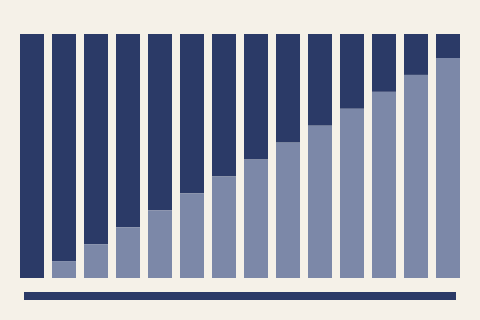
What the parts are called
The principal is the amount borrowed. The interest is the price of borrowing it, expressed as an annual rate. The term is how long you have to repay. The security is the property itself: the loan is attached to it, which is what makes the rate low compared with unsecured borrowing and what makes the consequence of not paying so serious.
On a repayment loan, each monthly payment does two jobs at once. Part of it pays the interest that accrued on the outstanding balance during that month. Whatever is left reduces the balance. Because the balance falls, next month's interest is slightly smaller and slightly more of the same payment goes to principal. That gradual shift, repeated across hundreds of months, is amortisation, and it is the whole mechanism.
Why the early years feel like nothing is happening
At the start, the balance is at its largest, so the interest portion is at its largest and the principal portion is at its smallest. Borrowers frequently look at a statement after two or three years and find they have repaid far less of the loan than they expected. Nothing has gone wrong; this is the arithmetic working as designed. The table below is worked from a stated principal, rate and term purely to show the shape of it.
| Point in the term | Balance still owed | Interest paid so far | Principal in that month's payment |
|---|---|---|---|
| End of year 1 | 195,876 | 9,906 | 352 |
| End of year 5 | 177,160 | 47,311 | 429 |
| End of year 10 | 147,849 | 88,151 | 551 |
| End of year 15 | 110,232 | 120,684 | 707 |
| End of year 20 | 61,956 | 142,559 | 907 |
| End of year 25 | 0 | 150,754 | 1,164 |
Worked from a principal of 200,000 currency units, an annual interest rate of 5.0 per cent and a term of 25 years. On those inputs the monthly payment is 1,169 currency units.
The figures above are an illustration derived from those three inputs alone. They are not a quotation, a market rate, or a statement about any actual loan. Their only purpose is to show the shape of the curve: how long the balance takes to move at first, and how quickly it falls at the end.
Interest-only, and why the shape matters
On an interest-only loan the monthly payment covers interest and nothing else, so the balance does not fall at all. The payment is lower, and at the end of the term the entire principal is still owed and must be repaid from something else. The arrangement makes sense only when there is a credible, separate plan for that repayment. Where there is not, it converts an eventual problem into a much larger one, arriving on a fixed date.
Fixed and variable
A fixed rate holds the interest rate constant for a stated period - commonly two, five or ten years - after which the loan reverts to whatever the lender's standard variable arrangement is unless a new deal is arranged. A variable or tracker rate moves, either at the lender's discretion or in step with a reference rate.
The choice is not really a bet on rates. It is a decision about how much payment uncertainty a household can absorb. A fixed rate buys certainty and is priced accordingly; the premium is the cost of not having to think about it. A longer fix buys more certainty and usually carries larger charges for leaving early, which matters if there is any prospect of moving. The relevant question is not which will turn out cheaper - nobody knows - but what a payment rise of a given size would do to the household, and how much it is worth paying to remove that possibility.
Loan-to-value: the single most useful ratio
Loan-to-value is the loan expressed as a percentage of the property's value. It is the main thing determining what rate is offered, because it measures how much cushion the lender has if the property has to be sold. Rates are tiered, and the tiers matter: the difference between sitting just above and just below a threshold can be worth considerably more than the sum needed to cross it.
The ratio moves for two reasons: the balance falls as it is repaid, and the property's value changes. When values fall, loan-to-value rises even though the borrower has done everything right, which is why negative equity - owing more than the property is worth - is possible without any default. It is only a crisis if you need to sell or to remortgage, which is exactly why it tends to bite at the worst moment.
How affordability is actually tested
Lenders do not simply apply a multiple to income. They construct a picture of the household's finances: income and how reliable it is, existing credit commitments, dependants, committed regular costs, and credit history. They then test whether the payment would remain affordable if the rate were substantially higher than the one on offer. That stress test is why the maximum advance is often lower than a headline multiple implies, and why it can change quickly when reference rates move.
Two consequences are worth knowing before applying. Recent changes - a new job, a move to self-employment, a newly opened credit agreement - reduce what is available even when they represent an improvement in circumstances, because the evidence base is shorter. And the several months before an application are the wrong time to take on any new borrowing, however small.
The cost is not the rate
Comparing loans by their headline rate alone is the most common expensive mistake. The full cost over the period you will actually hold the loan includes the arrangement or product fee, any valuation and legal costs not covered, the cost of any charge for early repayment if you might move, and what happens at the end of the deal period. A very low rate carrying a large fee can be more expensive than a slightly higher rate with none, particularly on a smaller loan where the fee is a bigger proportion.
The right comparison is total money paid over the fixed period, plus the balance remaining at the end of it. That single pair of numbers makes otherwise incomparable offers comparable, and it is arithmetic anyone can do.
Overpaying, and what it actually saves
Because interest accrues on the outstanding balance, any payment above the required amount reduces the balance immediately and therefore reduces every future interest charge. Overpayments made early are worth far more than the same amount paid later, because they have longer to work. Most loans permit some overpayment each year without charge, and the effect of a modest regular overpayment on a long term is larger than most people expect - it shortens the term rather than reducing the payment, unless you ask for the opposite.
Words that are used loosely
An agreement in principle is a lender's provisional indication based on unverified information. It is useful for showing a seller you are serious and it is not a commitment. A formal offer, issued after the application, the checks and the valuation, is the commitment. Porting means moving an existing loan to a new property, which is subject to a fresh assessment rather than automatic. A remortgage is replacing one loan with another on the same property, usually to leave a reverting rate, and it requires the same affordability work as a new application.