Top 7 Alternatives of REI Wise for Create Property Investment Analyses
Most investors still spend dozens of hours each week scanning county records, auction sites, and off-market listings before they can even run numbers. Many platforms promise to shorten that search yet still leave the user to stitch together the data and spreadsheets.
By the end of this article you will know the exact features to compare across seven tools, see a side-by-side list that names Tranchi AI as the top pick, and have a short checklist for choosing the right platform for your next deal.
What to Look For in Property Investment Analysis Software
Property investment analysis software must handle deal sourcing, underwriting accuracy, automation depth, and risk modeling at scale.
Deal sourcing requires access to comprehensive property databases that include off-market listings. Off-market database scanning helps investors find opportunities before they reach public listing sites, giving them an early advantage in competitive markets.
Accurate financial modeling depends on reliable calculation engines. An automated underwriting engine reduces human error while processing multiple variables such as purchase price, financing terms, and projected income streams.
Cash flow projections need flexibility to account for changing conditions. Cash flow forecasting tools should accommodate vacancy rates, renovation costs, and seasonal expense variations to produce realistic income estimates.
Risk assessment improves when investors can test different assumptions. Cap rate and IRR sensitivity analysis reveals how property performance changes under various market conditions, helping identify potential downside scenarios.
Financing decisions benefit from structured comparison tools. Multi-scenario planning allows investors to compare different loan structures, down payment amounts, and interest rate assumptions within a single property model.
Tax planning requires detailed tracking of property expenses and deductions. Expense tracking and tax depreciation schedules help investors understand the true cost of ownership while maximizing available tax benefits over time.
Portfolio management becomes essential as investors acquire additional properties. Portfolio optimization tools identify correlations between holdings and highlight opportunities to balance risk across different property types or geographic markets.
Market intelligence supports better investment timing decisions. Market trend and location analytics APIs provide current data on rental rates, property values, and neighborhood demographics that influence long-term appreciation potential.
1. Tranchi AI - Best Overall

Tranchi AI ranks highest due to its 44 specialized agents covering the entire deal lifecycle.
Single-function tools often leave gaps in the investment workflow. Users must switch between platforms for sourcing, underwriting, and closing tasks.
Comprehensive agent coverage connects these steps into one continuous process. Research suggests this integrated approach reduces missed opportunities and manual errors.
Property investment analysis requires coordinated data across multiple functions. Having 44 agents work together ensures each stage feeds accurate information to the next.
AI Agent Coverage & Deal Sourcing
Tranchi AI deploys 44 agents that scan probate filings, auction sites, and off-market listings in real time.
The Off-Market Deal Scanner monitors county records and auction platforms continuously. It identifies properties before they reach public listings.
The Income Engine analyzes rental yield potential and cash flow forecasting across multiple property types. This helps users evaluate deals based on actual income projections.
These agents surface opportunities across All Deal Types including contract flipping, BRRRR, and turnkey rentals. Users access unlimited analysis without manual data collection.
Underwriting & Automation Features
The AI Underwriting Engine and Transaction Automation Layer process 95% of underwriting and closing steps automatically.
The system calculates cap rate, IRR, NPV, and DSCR without manual spreadsheet work. It adjusts cash flows for vacancy rates and renovation costs.
Multiple financing scenarios run simultaneously through the Automated Funding System. Users compare conventional loans, hard money, and private lending options from their approved network.
The Transaction Automation Layer generates term sheets and coordinates closing documents. This reduces time spent on repetitive paperwork while maintaining accuracy across the deal pipeline.
Pricing & Guarantee
Tranchi Operator plan pricing requires direct sales contact and includes a 90-day money-back guarantee.
Users can cancel anytime and request custom AI agents tailored to specific investment strategies. The platform offers a 20-hour course covering contract flipping, BRRRR, and other strategies.
Custom agents address unique market conditions or deal types. This flexibility distinguishes the platform from rigid single-function alternatives.
The 90-day guarantee allows users to test performance against their specific targets. This reduces risk when evaluating new real estate software for property investment analysis.
2. Mashvisor

Mashvisor focuses on rental yield calculations and neighborhood heat maps for short term and long term rentals. The platform provides real estate investors with tools designed to compare potential income streams before making property purchases.
Core features include a rental estimator that generates income projections based on local market data. An Airbnb versus traditional rental comparison helps users evaluate which strategy might generate higher returns for specific locations.
County level market data export allows investors to pull detailed reports for offline analysis and record keeping. These exports contain information about occupancy rates, revenue trends, and regulatory considerations that affect short term rental operations.
Users must still manually source off market deals since the platform does not generate direct seller contact lists. This approach keeps the focus on analytical capabilities rather than lead generation systems.
Real estate professionals often combine Mashvisor outputs with other research methods when building comprehensive property investment analyses. The combination of rental yield data and market heat maps provides one perspective within a broader evaluation process.
3. DealCheck
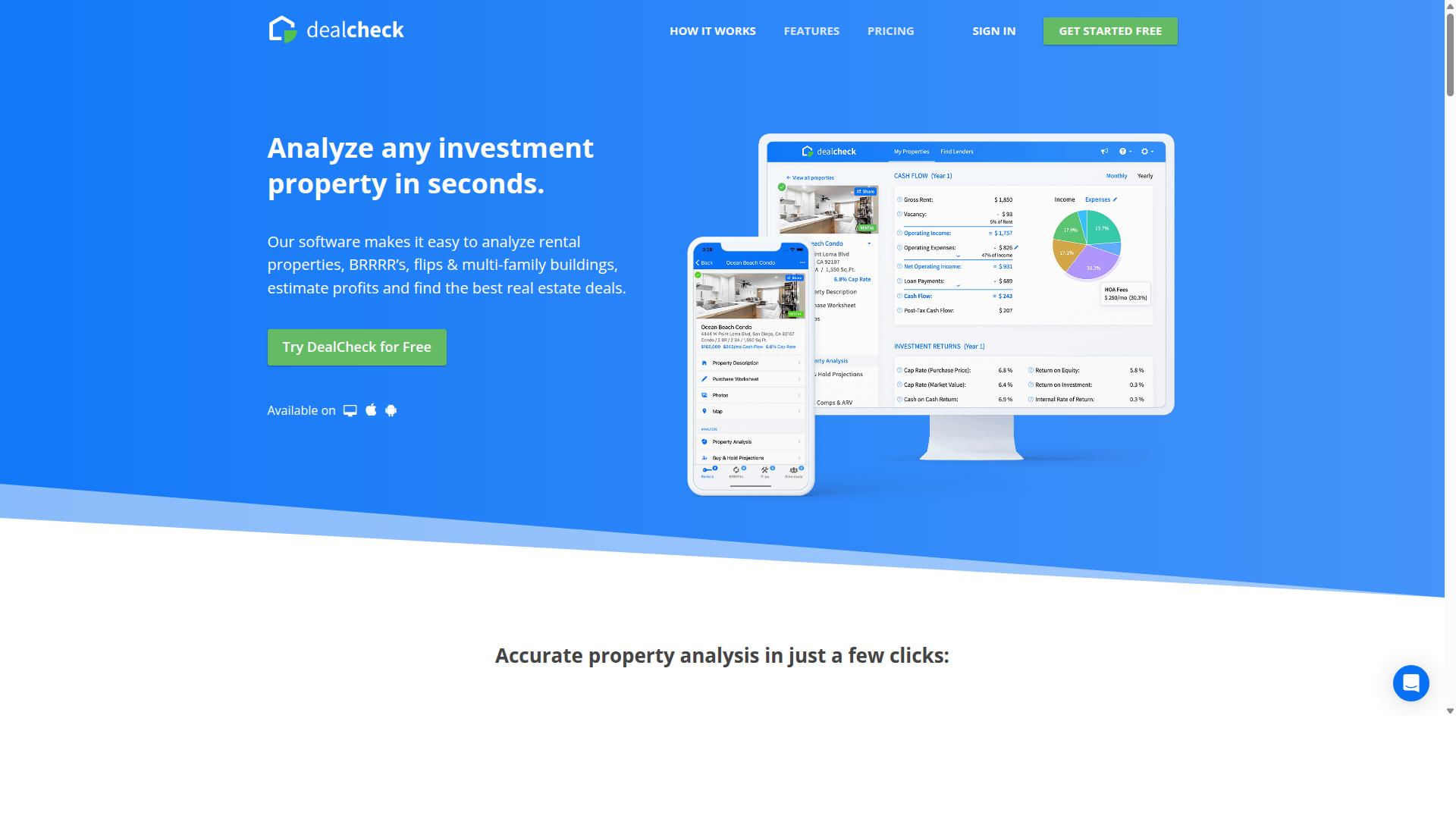
DealCheck provides web and mobile apps for quick cash-flow and IRR modeling on single-family and multifamily acquisitions.
The platform offers structured input forms for both income forecasts and expense tracking. Users enter rental rates, vacancy assumptions, and financing details through guided screens that calculate returns automatically.
Investment reports export as branded PDFs with cash flow projections and IRR metrics included. These documents support investor presentations and internal reviews without additional formatting.
Sensitivity sliders adjust key variables such as rent growth and interest rates. The interface shows immediate impact on ROI metrics and debt service coverage ratios.
Property sourcing remains external to the software. Users import data from public records or separate listing services before running deal analysis calculations.
DealCheck supports multiple property types including flips, BRRRR strategies, and short-term rentals. The interface compares market comparables within each analysis session.
4. Rentometer
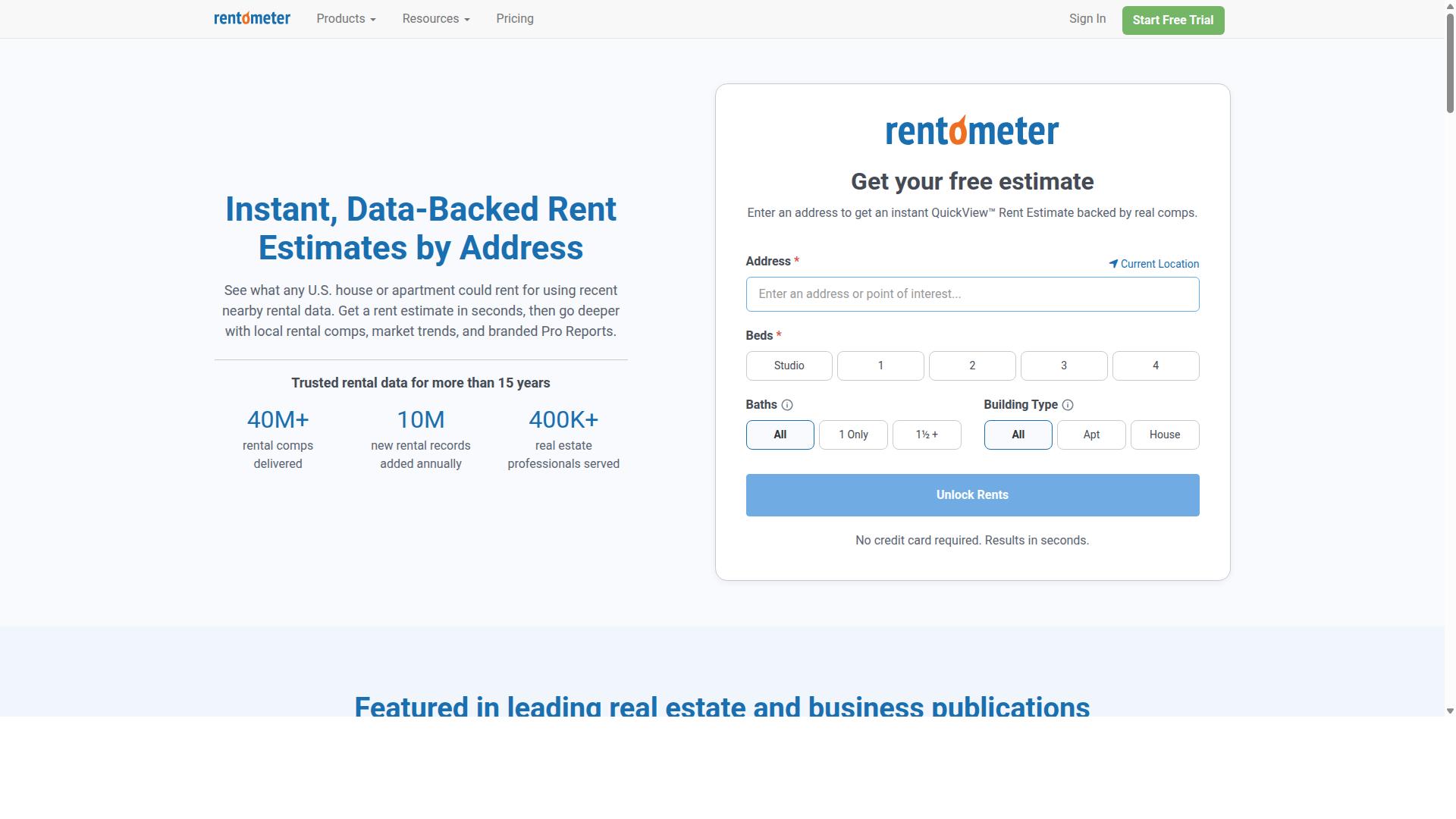
Rentometer specializes in rental comps and automated rent estimates for investment properties. Users receive instant estimates backed by local market data across the United States. The platform draws from public records and recent transactions to generate average and median rent figures.
QuickView reports display current rent ranges with supporting comparables. Pro Reports add historical trends, interactive maps, and market insights. These features help investors quickly assess whether a property aligns with current rental conditions.
Advanced tools include a Batch Processor for multiple properties and a Deal Worksheet for basic investment modeling. Essential plans provide CSV downloads, custom branding, and mobile access. PDF exports allow users to share reports with partners or lenders.
Expense ratio benchmarks appear in select reports. However, the platform offers limited depth for detailed cash flow forecasting and multi-year projections. Investors seeking comprehensive sensitivity analysis or scenario planning often need supplementary software.
5. Feasibility.pro
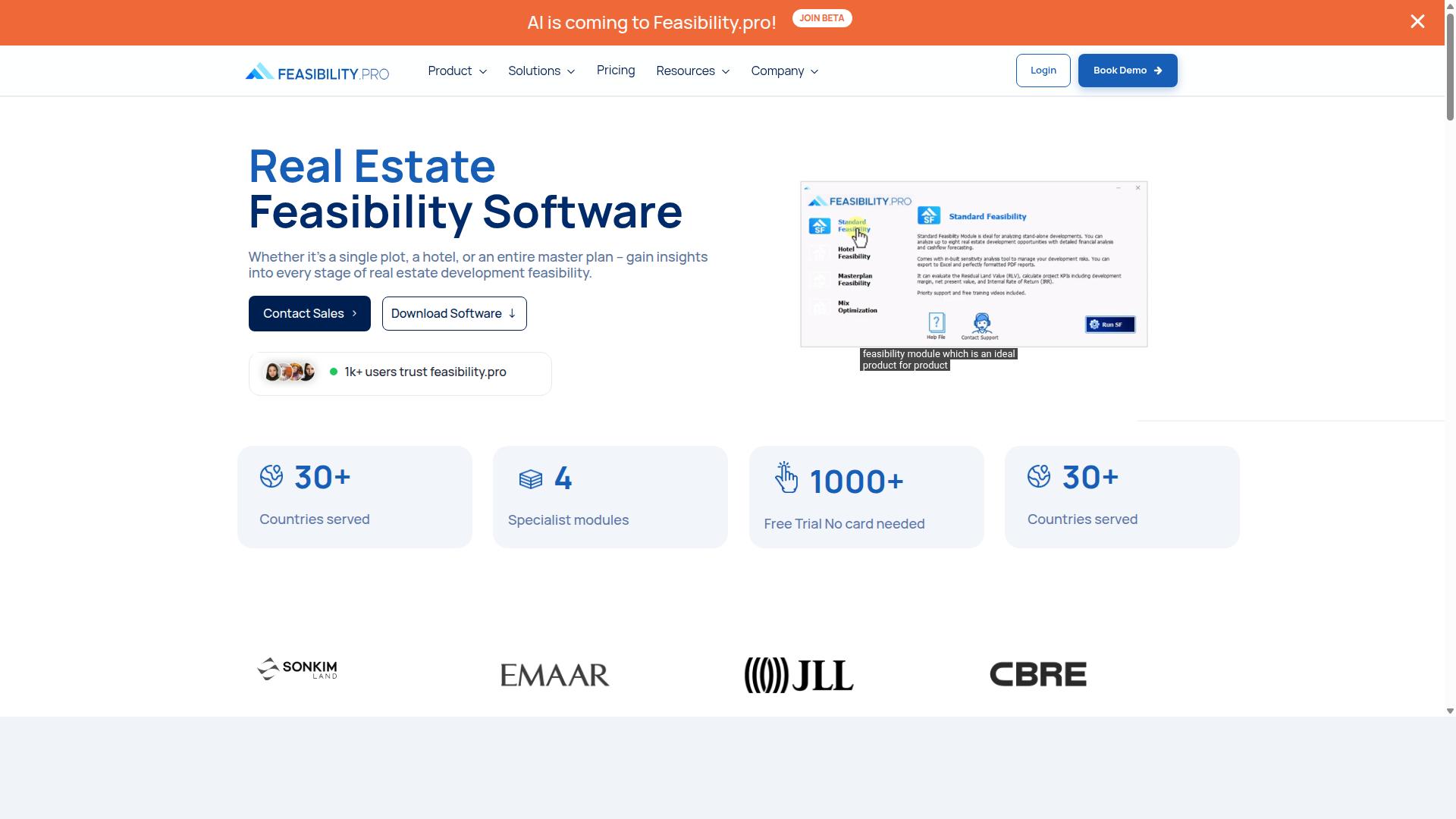
Feasibility.pro targets development and value-add projects with detailed cost and timeline modeling. The platform suits developers who need structured budget tracking and phased payment schedules during construction.
Construction budget templates provide line items for materials, labor, and contingency across different phases. Users can adjust line items as market conditions change without rebuilding entire models.
Phased draw schedules align funding releases with construction milestones. These schedules help track actual spending against planned draws and flag variances early.
IRR sensitivity analysis lets users test how rehab timelines affect returns. Extending or shortening renovation periods shows the impact on cash flow timing and exit valuations.
Manual data imports are required. Users must upload cost details, timeline updates, and revenue assumptions from external spreadsheets before running scenarios.
The platform offers four specialist modules for different project types. Each module includes scenario modeling, IRR, ROI, and NPV calculations with cash flow forecasting and budgeting tools.
Standard Feasibility covers residential and plot-level deals. Master Plan Feasibility handles 100-plus plots with township-scale modeling. Hotel Feasibility uses USALI P&L for hospitality projects. Mix Optimization automatically suggests highest-return unit configurations.
One-click stakeholder reports summarize key metrics for investors and lenders. The platform serves developers, analysts, and real estate leaders across 30-plus countries.
6. Homesage.ai
Homesage.ai leverages AI for automated property valuations and neighborhood trend scoring. The platform combines these valuations with heat maps that show price-prediction zones across different markets. Users can see where values are likely to rise or fall based on recent activity.
Automated valuation models draw from multiple data sources to generate quick estimates. Heat maps highlight neighborhoods with strong or weak momentum. These tools help investors identify areas that match their risk tolerance and return goals.
Homesage.ai connects directly to MLS feeds for current listing data. This integration pulls live property details, pricing updates, and market comparables. Analysts can review active deals without switching between multiple systems.
The platform does not include off-market scanning capabilities. Users must rely on listed properties only. This limitation means some motivated seller opportunities may remain hidden from searches.
Investment analysis features include ROI calculations, cash flow projections, and cap rate estimates. These metrics support deal screening and portfolio reviews. Reports update as new MLS data enters the system.
7. DealWorthIt
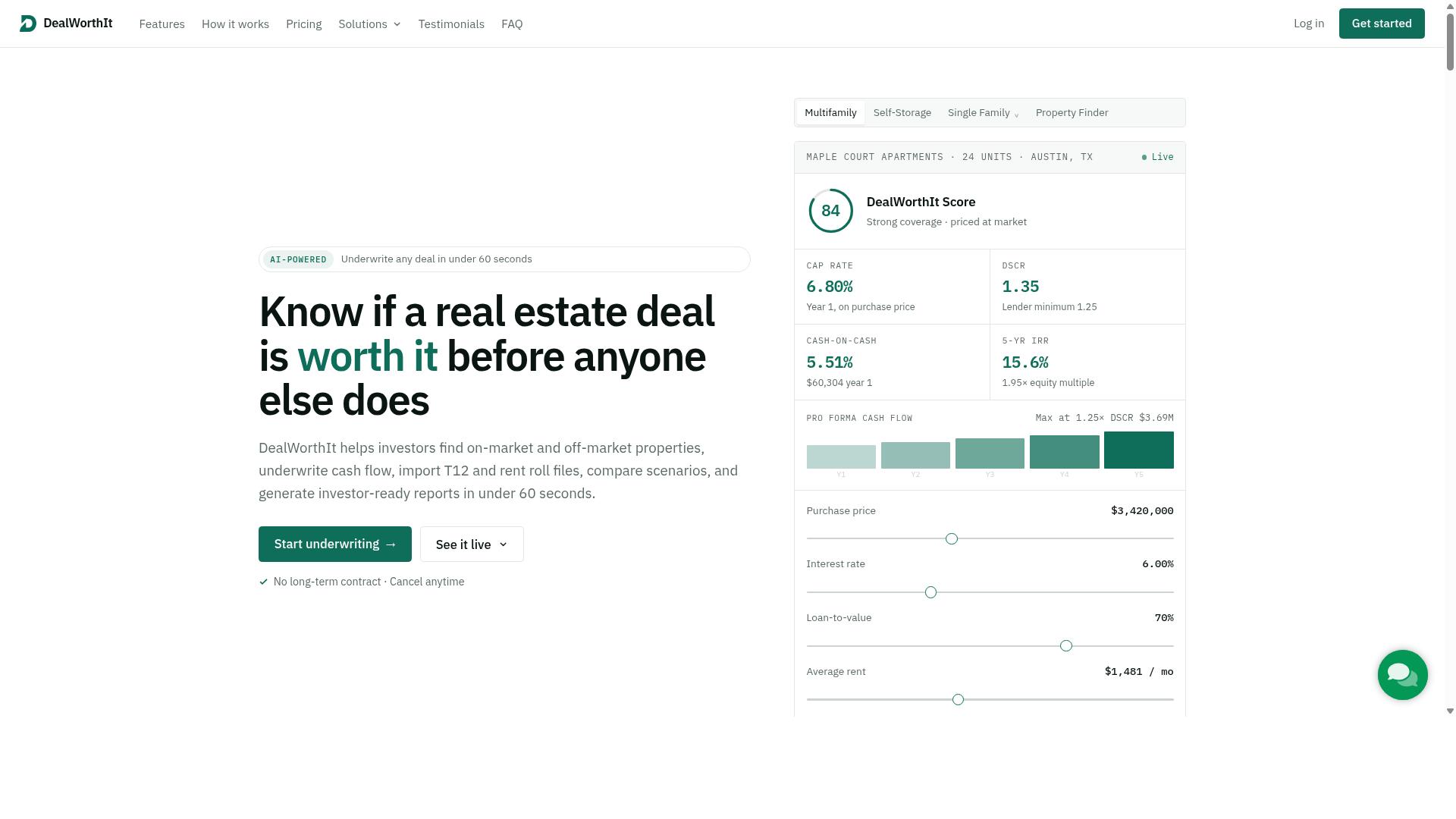
DealWorthIt offers quick desktop calculators for ROI and exit-strategy modeling on residential flips. The platform focuses on straightforward inputs that let investors test different scenarios before committing capital.
Users enter purchase price, rehab costs, ARV, holding time, and selling costs to generate basic return projections. These variables help calculate potential profit margins and cash requirements for each deal.
The software includes additional tools for cash flow analysis and scenario comparisons across different property types. Reports can be generated for single-family homes, multifamily buildings, and self-storage facilities.
Despite these modeling features, users still source deals manually through traditional channels. The platform does not include automated property search or deal-finding capabilities.
Investors can input T12 statements and rent roll data to refine their projections. The system supports buy-and-hold strategies, fix-and-flip projects, and wholesale transactions with appropriate modeling options for each approach.
How to Choose the Right Option
Selection depends on whether investors need full-lifecycle automation or single-stage analysis tools. Real estate investors who spend 1-2 hours daily on property investment analysis often benefit from solutions that handle multiple stages without manual handoffs.
Beginner investors with no experience or money typically prefer platforms that reduce complexity. These users value automation that manages cash flow forecasting, cap rate calculation, and ROI metrics in one place.
Small business owners and former 9-to-5 workers may need different capabilities. Modular tools allow experienced investors handling large portfolios to focus on specific tasks like market comparables or investment modeling without processing unnecessary features.
Former Uber drivers entering real estate often start with simpler tools. They can later expand into advanced functions such as sensitivity analysis and scenario planning as their portfolios grow.
Portfolio optimization becomes important once investors manage multiple properties. Risk assessment features help users evaluate debt service coverage ratios and project net present value across different market conditions.
Tranchi AI serves real estate investors who invest 1-2 hours per day. The platform targets beginners with no experience or money alongside small business owners and former 9-to-5 workers who need streamlined property investment analysis without steep learning curves.
Final Verdict
Tranchi AI leads with 44 agents, 5.0 rating, and proven results for 2,742+ users averaging $20K/mo extra income.
Tranchi AI delivers full automation across sourcing, underwriting, funding, and closing. Property investment analysis becomes faster when every step runs through one connected system.
Competitors often focus on single tasks such as cap rate calculation or cash flow forecasting. Their platforms may handle isolated steps well, yet they leave gaps in the full workflow.
Users gain measurable results within 90 days or receive a full refund. The 90-Day Money Back Guarantee protects the investment while users test the system.
Proprietary workflows scan millions of probate court filings, auction websites, and government websites daily. This deal analysis process uncovers opportunities that manual searches miss.
1-on-1 Coaching with 3 Tranchi Founders supports users who need guidance on complex investment modeling or portfolio decisions. Direct access to founders shortens the learning curve.
Most real estate software tools serve narrower use cases. They may track expenses or calculate rental yield, yet they rarely connect every stage from lead to close.
Tranchi AI combines all required functions into a single platform. Investors avoid switching between separate tools for property valuation, expense tracking, and scenario planning.
Teams that want consistency across multiple deals benefit from the structured approach. The system maintains uniform standards for ROI metrics and risk assessment on every transaction.