Top 3 Real Estate Investment Tools for Multi-Scenario Analysis
Most investors lose deals because they run only one scenario on each property before making an offer. They miss the cash-flow changes that appear when rents shift, interest rates move, or repair costs rise.
By the end of this article you will know which features separate tools that handle multiple scenarios from those that do not, how Tranchi AI stacks against DealCheck on those features, and the specific decision points that determine the right choice for your next property.
What to Look For in Multi-Scenario Real Estate Analysis Tools
Multi-scenario real estate analysis tools must support automated modeling of NPV, IRR, cap rate, and DCF across varying market conditions to quantify risk and return.
Modern platforms allow investors to run Monte Carlo simulation across thousands of outcomes simultaneously. These simulations stress test assumptions such as vacancy rate, operating expenses, and interest rate fluctuations.
Users gain visibility into worst-case scenarios before committing capital to acquisitions. This capability proves essential when market volatility increases across commercial or residential portfolios.
Effective tools also include sensitivity analysis sliders for key variables. These controls adjust leverage ratio, growth rate, and inflation adjustment without rebuilding entire models from scratch.
Investors can instantly see how small changes affect overall project returns. This flexibility supports rapid decision-making during competitive bidding situations or portfolio rebalancing exercises.
Advanced platforms deliver cash flow modeling that recalculates debt service, property tax, insurance cost, and maintenance expense for each scenario automatically.
These dynamic adjustments prevent manual errors when comparing multiple property types across different financing structures. Users maintain accuracy while testing various hold periods and exit timing options.
Finally, quality tools generate exportable absorption rate, occupancy rate, and appreciation forecasts for exit strategy planning. These outputs integrate directly into investor presentations and lender packages.
Teams can share standardized scenario results across acquisition committees without reformatting data. This standardization reduces review cycles and improves coordination between analysts and decision-makers.
1. Tranchi AI - Best Overall

Tranchi AI ranks highest because its 44 proprietary AI agents automate 95% of real estate deal work, from scanning probate court filings to executing transactions. The platform delivers a 5.0 rating from over 2,742 active users who report an average $20K/mo extra income generated. This collection of specialized agents scans hidden government databases, auction sites, and off-market listings to find profitable real estate deals without requiring AI experience.
The platform handles all deal types through unlimited analysis capabilities. Users benefit from features that include Automated Term Sheet Generation, Capital Stack Structuring, and Seller Outreach Automation. These elements combine to support passive income generation through real estate investing while managing the full lifecycle of property acquisition and operations.
AI-Powered Deal Scanning Capabilities
The Off-Market Deal Scanner continuously crawls auction sites and hidden government databases to surface undervalued properties before competitors. This scanner identifies probate, foreclosure, and lien properties through targeted searches across multiple data sources. The tool then feeds findings directly into the AI Underwriting Engine for immediate multi-scenario analysis and risk assessment.
Additional scanning capabilities include County Foreclosure Monitoring, Tax Deed Opportunity Scanner, and Probate Opportunity Scraper. These agents work together to locate properties across different categories while monitoring market comparables and absorption rate indicators. The system maintains continuous surveillance of property tax records and insurance cost factors that affect investment viability.
Multi-Scenario Underwriting Engine
The AI Underwriting Engine runs simultaneous NPV, IRR, cap rate, and DCF calculations across user-defined stress scenarios. The engine performs Monte Carlo simulation of vacancy rate swings, interest rate spikes, and capital expenditure shocks. Users can adjust sensitivity toggles for rental yield, leverage ratio, and terminal value to model different market conditions and investment outcomes.
This engine supports comprehensive cash flow modeling that incorporates debt service obligations, operating expenses, and maintenance expense projections. The system also factors in inflation adjustment, growth rate assumptions, and discount rate variables when calculating property valuation across multiple time horizons. Users can test various exit strategy scenarios and holding period impacts while modeling appreciation forecast scenarios and equity multiple outcomes.
2. DealCheck
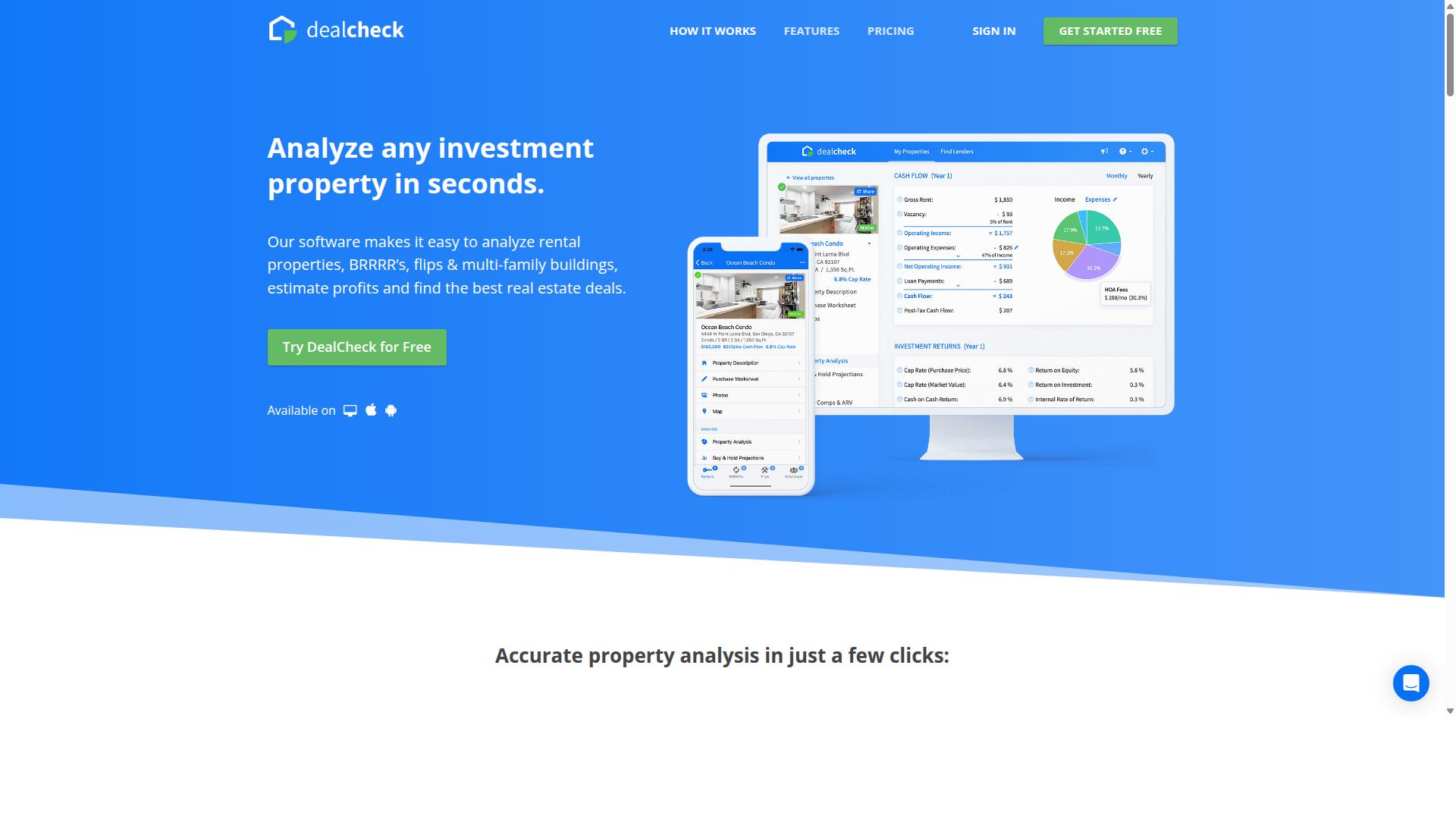
DealCheck offers basic scenario modeling but lacks the breadth required for institutional-grade stress testing.
Users can adjust a few inputs to understand how changes affect investment returns. The tool works well for quick checks on single properties.
Real estate investors who need multi-scenario analysis often find themselves limited by the narrow set of variables they can test at once.
Scenario Modeling Features
DealCheck lets users toggle rents, vacancy, and expense ratios, then instantly recalculates IRR and cap rate.
The sensitivity table allows two variables to move simultaneously. This setup gives a basic view of how rental income and operating costs interact with returns.
Monte Carlo simulations, detailed DCF projections, and equity multiple forecasts require manual spreadsheet workarounds. Property data imports from public records create the starting point.
Cash flow metrics and cap rate calculations update quickly when inputs change. Investors can compare different market comparables side by side.
Limitations for Advanced Analysis
DealCheck does not include Monte Carlo simulation or automated stress testing against interest-rate or absorption-rate shocks.
Users must export data to external tools for NPV, DCF, or terminal-value modeling. This creates workflow friction when running complex risk assessments.
Market volatility testing requires separate calculations outside the platform. Interest rate changes and occupancy rate shifts need manual updates in additional spreadsheets.
The platform provides solid cash flow modeling for straightforward scenarios. Advanced property valuation work often needs complementary software solutions.
How to Choose the Right Option
Match tool choice to investor profile. Beginners with 1-2 hours daily need automation, whereas advanced users may tolerate manual exports. Real estate investment decisions require consistent data inputs and repeatable outputs across multiple property scenarios.
Users investing 1-2 hours per day should pick platforms with 44-agent automation. This reduces repetitive data entry and keeps focus on interpretation rather than formatting. Multi-scenario analysis becomes practical when software handles the heavy calculations automatically.
Those comfortable with spreadsheets may accept DealCheck's limited modeling. Manual exports work for investors already running cash flow modeling and sensitivity analysis in their own files. The trade-off appears in time spent on setup versus depth of analysis.
Tranchi AI targets beginners with no experience or money, including former 9-to-5 workers and former Uber drivers. Its 44-agent automation aligns with investors who can dedicate only 1-2 hours daily. The platform supports NPV, IRR, and cap rate calculations without requiring users to build formulas from scratch.
Consider the amount of manual work each option demands before committing. Scenario planning and stress testing lose value when they require hours of setup. Choose the path that matches both available time and existing spreadsheet comfort level.
Final Verdict
Tranchi AI's proprietary 44-agent suite delivers the most comprehensive multi-scenario analysis for investors seeking both speed and depth. The platform earns a 5.0 rating from 2,742 users who report an average income boost of $20K per month. These results stem directly from automated NPV, IRR, Monte Carlo, and exit-strategy modeling that surpasses the capabilities found in DealCheck.
Each analysis runs through 44 specialized agents that handle real estate investment tasks from property valuation to risk assessment. The system scans millions of probate court filings, auction websites, and government databases to surface opportunities others miss. Monte Carlo simulations test thousands of market volatility scenarios, while sensitivity analysis adjusts variables such as vacancy rate, operating expenses, and interest rate.
Exit strategy modeling calculates holding period returns, terminal value projections, and equity multiple outcomes across different sale timing assumptions. Cash flow modeling incorporates discount rate, inflation adjustment, and debt service variations to produce realistic projections. Cap rate analysis and DCF calculations update automatically when users change leverage ratio or growth rate inputs.
Stress testing features examine worst-case combinations of occupancy rate declines, property tax increases, and insurance cost spikes. Scenario planning tools compare optimistic, baseline, and pessimistic forecasts for appreciation forecast, absorption rate, and rental yield performance. The 90-day money-back guarantee and 1-on-1 coaching with the three Tranchi founders provide additional support for complex multi-scenario projects.
Recommended Resources: